TECHNICAL CASE STUDY · Desktop · Systems
Pulse Node Manager
A node operator’s control room.
Public pre-preview · platform qualification in progress
FROM THE IMPLEMENTATION
Require explicit update recovery
pub(crate) fn require_absent(options: &SupervisorOptions) -> Result<(), CoreError> {
    if load(options)?.is_some() {
        return Err(invalid(
            "an interrupted update requires explicit recovery before another operation",
        ));
    }
    Ok(())
}An interrupted update is durable state. Reject conflicting operations until the operator explicitly recovers it.
THE ENGINEERING PROBLEM
What needed to work
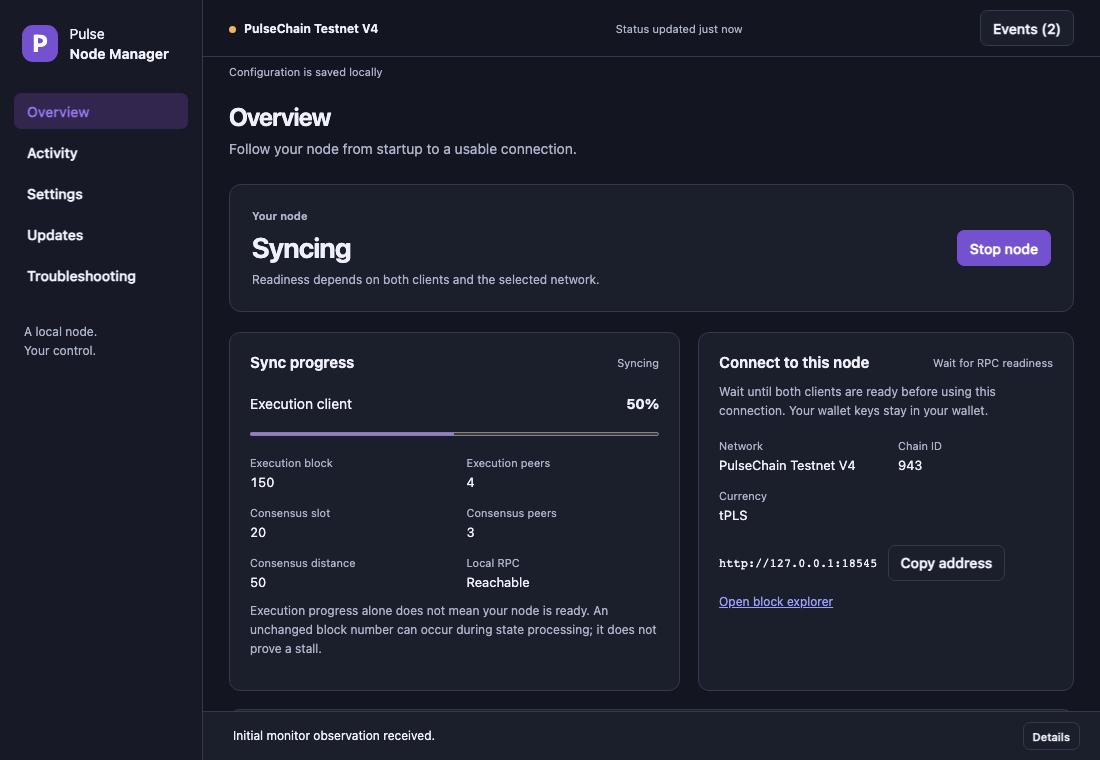
Running a full node should not require an operator to reason about containers, client compatibility and partial synchronization before understanding what to do next. I built Pulse Node Manager as a Rust supervisor with a CLI, local dashboard and Tauri desktop interface. Its job is to make node lifecycle and recovery explicit while keeping the execution and consensus clients as upstream components.
Constraints and requirements
- A node consumes substantial memory, CPU and SSD space. The selected network, storage location and local Docker environment must be checked before downloading chain data.
- Updates can be interrupted between stopping old clients and establishing new ownership. Chain data must survive normal lifecycle operations, and unrelated containers must never become cleanup targets.
ARCHITECTURE & DESIGN
How the system fits together
- CLI / Tauri / local web UI
- Rust supervisor + signed profiles
- Preflight + operation journal
- Execution / consensus containers
- Readiness + recovery
The interfaces call a shared Rust core instead of independently issuing container commands. Signed runtime manifests identify permitted profiles, while storage selection, Docker targeting and operation locks establish the installation boundary.
Readiness combines execution identity and synchronization with consensus observations. An update journal records replacement phases and owned containers separately from the receipt for a completed running deployment.
Decisions and tradeoffs
Treat startup as a guided preflight workflow, not just a launch command.
Structured checks report observed and required resources, blocked or unknown states, port ownership and remediation before expensive work begins.
Tradeoff Platform discovery requires adapters and tests. Stopping on missing evidence is more conservative than attempting a launch and hoping it succeeds.
Separate staging, application and recovery of an update.
Staging validates a candidate without changing running clients. Applying uses guarded replacement and a bounded readiness gate; failed readiness triggers restoration, while an interrupted journal requires deliberate recovery.
Tradeoff The state machine and durable records are more involved than replacing container images directly, but preserve the distinction between intended and observed ownership after a crash.
Separate controlled client builds from installed-application qualification.
Pinned build recipes, executable-format checks and repeat-build comparisons identify what was built. Native execution and full node behavior need their own evidence.
Tradeoff A green compilation pipeline cannot finish every platform lane. This separation exposes remaining qualification work instead of presenting packaging as proof that an installed node will operate correctly.
PLANNING & EXECUTION
From requirements to working behavior
- I implemented the shared lifecycle model first-class across CLI and desktop views: selected network, resource budget, progress, readiness, bounded logs and recovery actions refer to the same underlying installation.
- Delivery also included installer verification and client build/packaging integration. The owned work surrounds upstream clients with portability, provenance and operator workflows; it does not replace their protocol implementations.
VALIDATION & RECOVERY
How the behavior is checked
- Maintained tests cover manifest validation, readiness observations, cancellation, failed health gates, interrupted updates and rollback crash paths. Injectable clocks and command boundaries make lifecycle failures reproducible without a full chain sync.
- Renderer and installer checks address the user-facing handoff. Real operating-system execution remains a separate qualification boundary; the product is a public pre-preview, and final qualification across every required platform remained open.
Implementation references
Repository-relative references identify the implementation behind this case study. Selected code excerpts are also available in the portfolio.
- PulseNodeManager/crates/pns-core/src/preflight.rs
- PulseNodeManager/crates/pns-core/src/health.rs: readiness_state
- PulseNodeManager/crates/pns-core/src/lifecycle_update.rs
- PulseNodeManager/crates/pns-core/src/lifecycle_update_health.rs: wait
- PulseNodeManager/crates/pns-core/src/update_transaction.rs
- PulseNodeManager/crates/pns-core/src/update_transaction_recovery.rs
- PulseNodeManager/crates/pns-core/src/lifecycle_update_rollback_crash_tests.rs
- PulseNodeManager/apps/pulse-node-manager/tests/renderer.test.mjs
- PulseNodeManager/client-builds/README.md